


- Главная
- /
- Блог руководителя
- /
- RICS artificial intelligence in construction report 2025
RICS artificial intelligence in construction report 2025
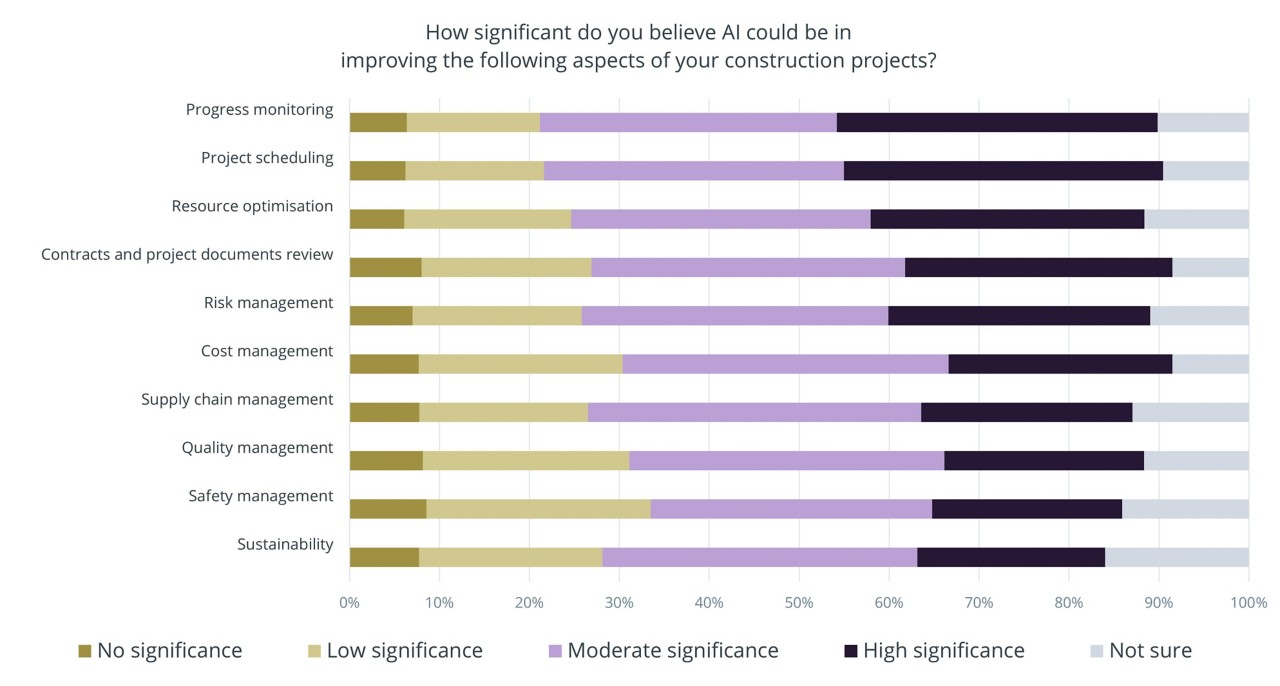
While sustainability and safety management trail slightly behind other core areas of project execution, they still received a significant percentage of favourable responses. Their position as the lowest-ranked areas on this question may reflect current limitations in AI’s integration with upstream design tools and downstream supply ecosystems.
Nevertheless, the relatively low expectations for AI’s positive impact on sustainability and safety management warrant deeper examination, as this counterintuitive finding suggests several concerning possibilities: limited awareness of AI's potential in these critical areas, insufficient integration between AI strategies and sustainability objectives, or a fundamental misunderstanding of how AI can enhance safety and environmental performance. Given the mounting pressure to improve both sustainability and safety outcomes, this perception gap may represent a substantial missed opportunity. Organisations that successfully apply AI to these areas may gain significant competitive and regulatory advantages over others who focus on more obvious applications.
3.4 Lack of skilled personnel is the most cited barrier to AI adoption
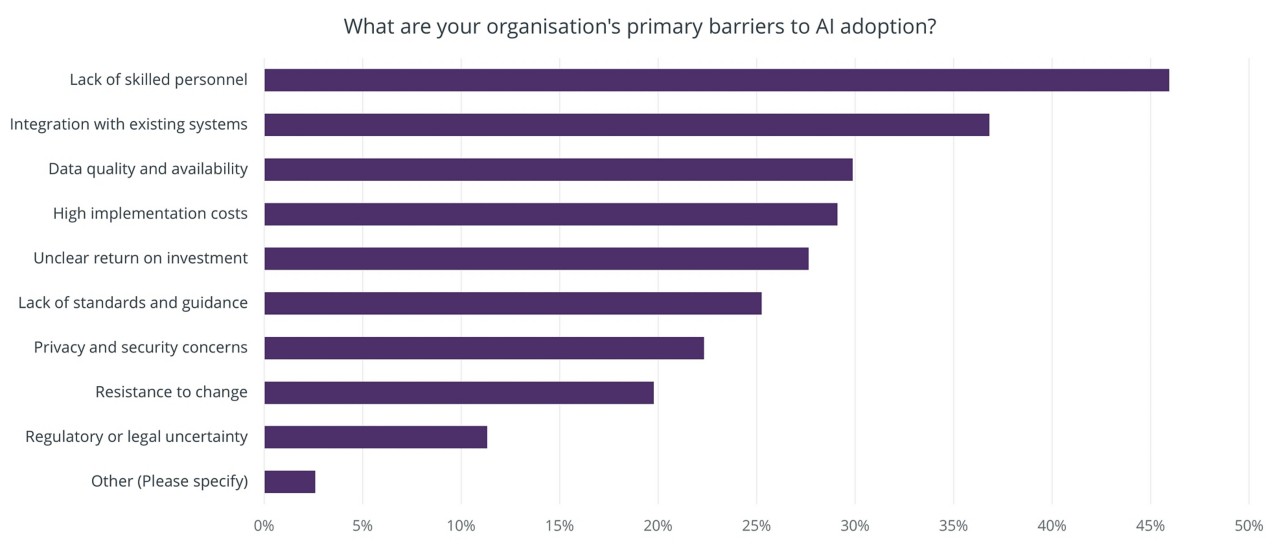
Despite growing interest, several practical barriers constrain AI adoption in the construction sector. When asked to list their top three challenges, the following were selected most frequently by respondents (see Figure 4).
- Lack of skilled personnel (46%).
This points to a widespread talent gap or lack of AI literacy across the sector worldwide. This may reflect a broader shortage of digital skills within construction, as well as limited availability of training tailored to AI in real-world project contexts.
- Integration with existing systems (37%).
This indicates companies' desire to ensure that the AI systems they adopt will work with their current solutions, underscoring the need for interoperable systems, flexible integration options and greater transparency from technology vendors to support adoption.
- Data quality and availability (30%).
This is a foundational requirement for effective AI use, as high-quality, structured data is essential for fine-tuning and deploying AI models. However, many firms still struggle with fragmented, incomplete or inconsistent data. This barrier may be especially acute in small and mid-sized organisations with limited digital infrastructure.
High implementation costs, selected by 29% of respondents, and unclear return on investment (28%) reflect concerns about financial risk and uncertainty. These rankings suggest that many entities remain unconvinced of AI’s near-term value or are hesitant to commit funding without proven results. The novelty of AI solutions, lack of case studies and variable vendor offerings may contribute to this uncertainty.
Lack of standards and guidance (25%) reinforces the perception that the AI landscape is still emerging, with few established best practices in the construction context. This may leave firms unsure of how to assess or govern AI use responsibly.
The lowest-ranked barriers globally are:
- regulatory or legal uncertainty (11%)
- resistance to change (20%) and
- privacy and security concerns (22%).
These lower-ranked barriers may appear less pressing today but could grow in importance as adoption increases. Their current ranking may reflect limited real-world exposure to AI applications, or a lack of awareness of how emerging regulations could affect future use.
Barriers listed under ‘other’ generally related to AI being irrelevant to the organisation’s services or to distrust of the technology in its current stage of development.
All these barriers do not operate in isolation but create compounding effects that can significantly delay adoption. The skills shortage directly impacts integration capabilities, while poor data quality undermines the business case needed to justify high implementation costs. To achieve successful AI adoption, organisations will need to address these barriers systematically rather than in isolation.
3.5 Professionals expect AI to have the most significant impact on design optioneering
Over the next five years, construction professionals expect AI to have the most significant impact in a few high-potential areas. Respondents were asked to select the one area where they anticipated AI would have the most significant influence (see Figure 5), and the results revealed a noteworthy shift: while AI is currently viewed as most valuable in tactical areas such as progress monitoring and scheduling (see Figure 3), professionals anticipate its future impact will be greatest in strategic functions like design optioneering. This reflects growing optimism about AI's role in shaping early-stage decision making rather than simply improving execution later in the project life cycle.
- Design optioneering (40%). With remarkable global consensus across the construction industry, this area was selected as being where AI's primary value proposition lies. With growing pressure to build smarter and faster, AI-led design evaluation could become the next frontier of competitive advantage.
- Skills training (13%). The survey participants’ responses suggest an industry recognition that AI could help address the workforce development challenges identified as current barriers to adoption in section 3.4. It also indicates that respondents see AI adoption requiring new skills from construction professionals, while at the same time providing the sector with new solutions for skills development.
- Regulatory compliance (11%), autonomous robotics (10%) and predictive digital twins (10%). These areas occupy the middle tier of expectations and represent more specialised AI applications that may require longer development cycles or more significant changes.
- Other focus areas included low-carbon and circular construction (8%) and safety and well-being (6%).
Areas listed under ‘other’ include document drafting, operational efficiency and ‘none’.


 Презентация